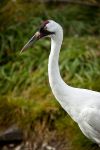
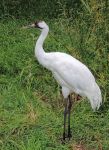
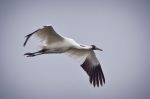
Whooping crane (Grus americana)
The whooping crane is the tallest North American bird, named for its whooping sound. At one time, the range for these birds extended throughout midwestern North America. In 1941, the wild population consisted of 21 birds. Conservation efforts have led to a population increase; as of April 2007 there were about 340 whooping cranes living in the wild, and another 145 living in captivity. The whooping crane is still one of the rarest birds in North America and it is still considered as Endangered by the IUCN. The species can stand up to 1.5 m and have a wingspan of 2.3 m. These birds forage while walking in shallow water or in fields, sometimes probing with their bills. They are omnivorous and more inclined to animal material than most other cranes. In their Texas wintering grounds, this species feeds on various crustaceans, mollusks, fish, berries, small reptiles and aquatic plants. Potential foods of breeding birds in summer include frogs, small rodents, smaller birds, fish, aquatic insects, crayfish, clams, snails, aquatic tubers, and berries.

 The Light in the Sky